
Designing Without Interiors: Seven Pedagogical Exercises on Body, Climate, Territory, and Politics
DOI:
https://doi.org/10.64197/REIA.27.1035Keywords:
architectural pedagogy, transitional space, climate and comfort, relational inhabitation, body and territoryAbstract
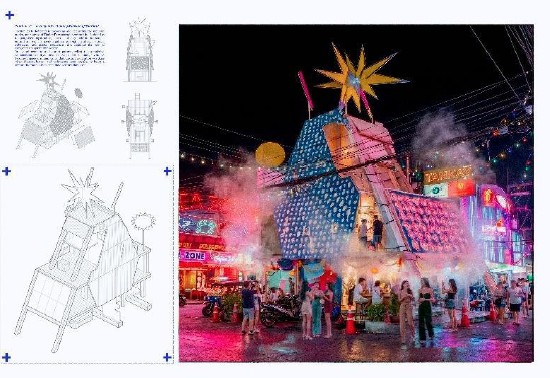
This article presents seven pedagogical exercises developed within the Architectural Design Area at Universidad Europea de Madrid in response to the thematic framework Architecture Without Interiors. Conceived as transversal explorations across different academic levels, the projects examine how architectural thinking shifts when the interior is no longer treated as a stable point of departure. Through strategies based on networks, minimal devices, atmospheric gradations, and relational sequences, the exercises investigate how space emerges from the interaction between body, climate, territory, and collective life. Rather than defining enclosure, the projects test transitional conditions, porous limits, and negotiated comfort. Read together, they reveal teaching as a laboratory where architectural intelligence develops through experimentation, adjustment, and situated engagement.
Downloads
Downloads
Published
Versions
- 2026-03-13 (2)
- 2026-02-19 (1)
How to Cite
Issue
Section
License
Copyright (c) 2026 José Luis Esteban Penelas, Beatriz Inglés Gosálvez, Zuhal Kol, María Martínez Morón, Nestor Montenegro Mateos, Paula Montoya Sáiz, Rubén Morillo Villar, Javier Mosquera González, Jorge Nieto Pujol

This work is licensed under a Creative Commons Attribution 4.0 International License.