
The Influence of Japanese Tradition on SANAA
Reinterpreting the Engawa and Ma in Contemporary Architecture
DOI:
https://doi.org/10.64197/REIA.27.1020Keywords:
Arquitectura japonesa, SANAA, Japón, Arquitectura tradicional, Arquitectura contemporaneaAbstract
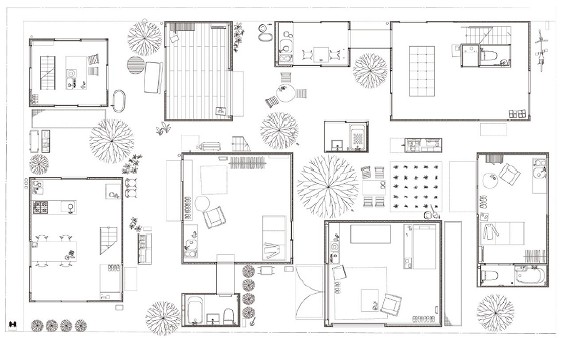
Throughout history, architecture has reflected the relationship between humans and their environment, adapting to the resources, climate, and culture of each territory. However, the industrialization of the 19th and 20th centuries and the subsequent globalization fostered architectural homogenization and a growing detachment between construction and context. In Japan, this phenomenon profoundly transformed traditional architecture—characterized by the temporality of materials, spatial fluidity, and integration with nature—in favor of more standardized Western models. Nevertheless, since the mid-20th century, Japanese architectural studios such as SANAA have sought to reconcile contemporary architecture with local identity, in line with the concept of Critical Regionalism explored by Frampton. In works such as the Moriyama House, the Rolex Learning Center, and Grace Farms, SANAA reinterprets traditional concepts such as ma (interval), engawa (transitional space), and the continuity between interior and exterior, creating versatile, luminous, and permeable spaces that engage in dialogue with their surroundings. Thus, contemporary Japanese architecture has established itself as a model that harmonizes technology and tradition, proposing a global architectural language that preserves Japan’s spatial and cultural sensibility.
Downloads
Downloads
Published
Versions
- 2026-03-16 (2)
- 2026-02-19 (1)
How to Cite
Issue
Section
License
Copyright (c) 2026 Diego Martín de Torres

This work is licensed under a Creative Commons Attribution 4.0 International License.